Key Stage 5 - A Level RS
A-Level Religious Studies
Religious Studies continues into the Sixth Form, providing students with the opportunity to explore theological, philosophical and ethical questions in considerably greater depth.
Our A-Level Religious Studies curriculum develops a profound understanding of philosophical, ethical and theological concepts while promoting critical thinking, analytical skill, independent judgement and the ability to construct reasoned arguments.
Students follow the Edexcel A-Level Religious Studies specification, studying three components:
Philosophy of Religion | Religion and Ethics | New Testament Studies.
Philosophy of Religion
Students explore classical and contemporary arguments for and against the existence of God, religious language, the problem of evil and other fundamental philosophical questions concerning religious belief.
Religion and Ethics
Students encounter major ethical theories, their application to contemporary ethical questions and, as their studies progress, increasingly sophisticated questions within meta-ethics.
New Testament Studies
Students develop detailed knowledge of the historical and cultural context of the New Testament, key theological themes and scholarly interpretations of New Testament texts.
Pupils are taught for 9 hours a fortnight in Years 12 and 13. Over the course of two years, they study the following components:
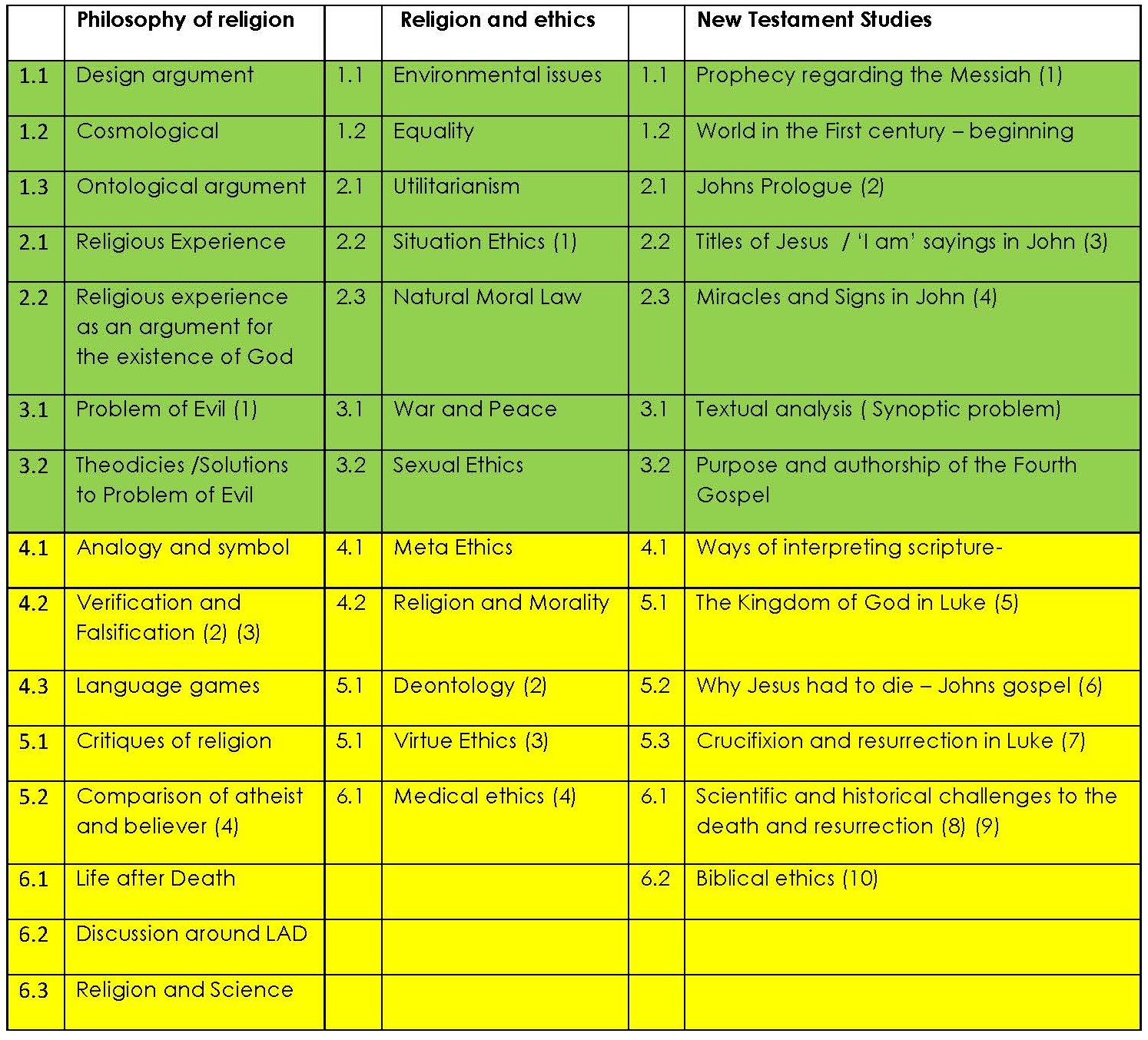
All pupils are set regular essays at the end of each unit of study to check their knowledge and understanding. Home learning takes the form of weekly reading and completion of tasks in preparation for the following lesson. They are expected to deepen their knowledge and understanding through independent study and show evidence of wider reading in their written work. The sections highlighted in green and yellow are the topics students will study in Years 12 and 13 respectively. Further information relating to the A-level course can be found here:
Progression through A-Level
The course is carefully sequenced across Years 12 and 13.
During Year 12, students establish secure foundations in philosophical arguments concerning the existence of God, challenges to religious belief, major ethical theories and the historical and cultural context of the New Testament. They develop their ability to use evidence and specialist terminology and begin to construct increasingly sophisticated evaluative arguments.
In Year 13, students engage with more advanced philosophical, ethical and theological questions, including religious language, life after death, meta-ethics, and developments in New Testament scholarship. They are increasingly expected to synthesise knowledge and construct balanced, nuanced and well-supported arguments.
Teaching includes questioning and debate, close textual analysis of primary sources, structured essay writing, regular assessment and deliberate interleaving of topics to promote long-term retention and synthesis.
A-Level and our Catholic educational mission
A-Level Religious Studies makes an important contribution to the Catholic educational mission of St Bede's. Students are encouraged to ask challenging questions about God, faith, morality and what it means to be human. Through the study of theology, philosophy, ethics and Scripture, they learn to examine different arguments carefully, support their own conclusions with evidence and engage respectfully with views different from their own.
The course therefore develops not only examination knowledge and academic skills, but thoughtful young adults capable of engaging intelligently with questions of faith, truth, morality and human flourishing.