Religious Formation

Religious Formation
‘Religious education is more than just one subject in the curriculum. In Catholic schools, it is the core of the “core curriculum”’.
(Pope St. John Paul II, 1988)
At the heart of every Catholic school is the person of Jesus Christ. This presence of Christ is in the present tense: it is a real presence, in the here and now. Recognition of it impacts on everything a Catholic school is and does, not least in its religious education.
Religious Education is the ‘core of the core curriculum’ in a Catholic school (Pope John Paul II), and placing it at the core of the curriculum helps us to fulfil our mission to educate the whole person in discerning the meaning of their existence. Religious Formation is not only concerned with intellectual knowledge “but also includes emotional and affective learning. It is in the mystery of the Word made flesh that the mystery of what it is to be human truly becomes clear. Without religious education, pupils would be deprived of an essential element of their formation and personal development, which helps them attain a vital harmony between faith and culture." (Religious Education Curriculum Directory, p4)
Religious Education at St Bede's
Religious Education is at the heart of the curriculum at St Bede's Catholic College. As a Catholic community, we recognise Religious Education as central to our mission: enabling every young person to grow in knowledge and understanding, to encounter the richness of the Catholic faith and tradition, and to develop the confidence to engage thoughtfully with questions of faith, meaning, truth and human life.
At St Bede's, Religious Education is known as Religious Formation. This reflects our understanding and belief that the subject is both academically rigorous and an important part of the education and formation of the whole person.
Through Religious Formation, pupils develop a secure and increasingly sophisticated understanding of Sacred Scripture, Catholic teaching and tradition, the person and mission of Jesus Christ, the sacramental life of the Church and the relationship between faith and contemporary life.
Pupils also encounter other religious traditions and perspectives. They are encouraged to ask challenging questions, think critically, engage respectfully with different viewpoints and articulate reasoned responses using increasingly precise religious and theological vocabulary.
We endeavour to foster a love of Religious Formation to ensure that when our pupils leave St Bede’s, they will be religiously literate and will reflect spiritually, act ethically, and think theologically in a multi-faith society. It is our aim that they go on to fulfil their mission and have a deep sense of respect, responsibility, and resilience to prepare them for future life as a citizen of God’s world. In addition, we want all our pupils to discern their call as stewards of God’s creation, their role in school, the communities they serve, and the world we live in. We aim for all our pupils to develop a deep understanding of the Catholic faith and of Christ's call to love and serve others, enabling them to reflect upon their own beliefs and respond thoughtfully to questions of faith, meaning and human life."
Our Curriculum Intent
Our Religious Formation curriculum seeks to develop pupils' knowledge, understanding and theological literacy through a carefully planned and progressively challenging curriculum.
We aim to enable pupils to:
- develop secure knowledge and understanding of Catholic belief, teaching, tradition and practice;
- encounter and interpret Sacred Scripture with increasing knowledge and confidence;
- understand the person, life and mission of Jesus Christ and the life and mission of the Church;
- develop an understanding of the sacramental and prayer life of the Catholic Church;
- use religious and theological vocabulary accurately and confidently;
- recognise connections between different areas of theological knowledge;
- engage with philosophical, ethical and theological questions;
- understand and engage respectfully with other religious traditions and perspectives;
- analyse and evaluate religious beliefs and arguments with increasing sophistication;
- make connections between faith, human experience, culture and contemporary life.
Religious Formation therefore makes a distinctive contribution to both the academic curriculum and the wider Catholic mission of St Bede's.
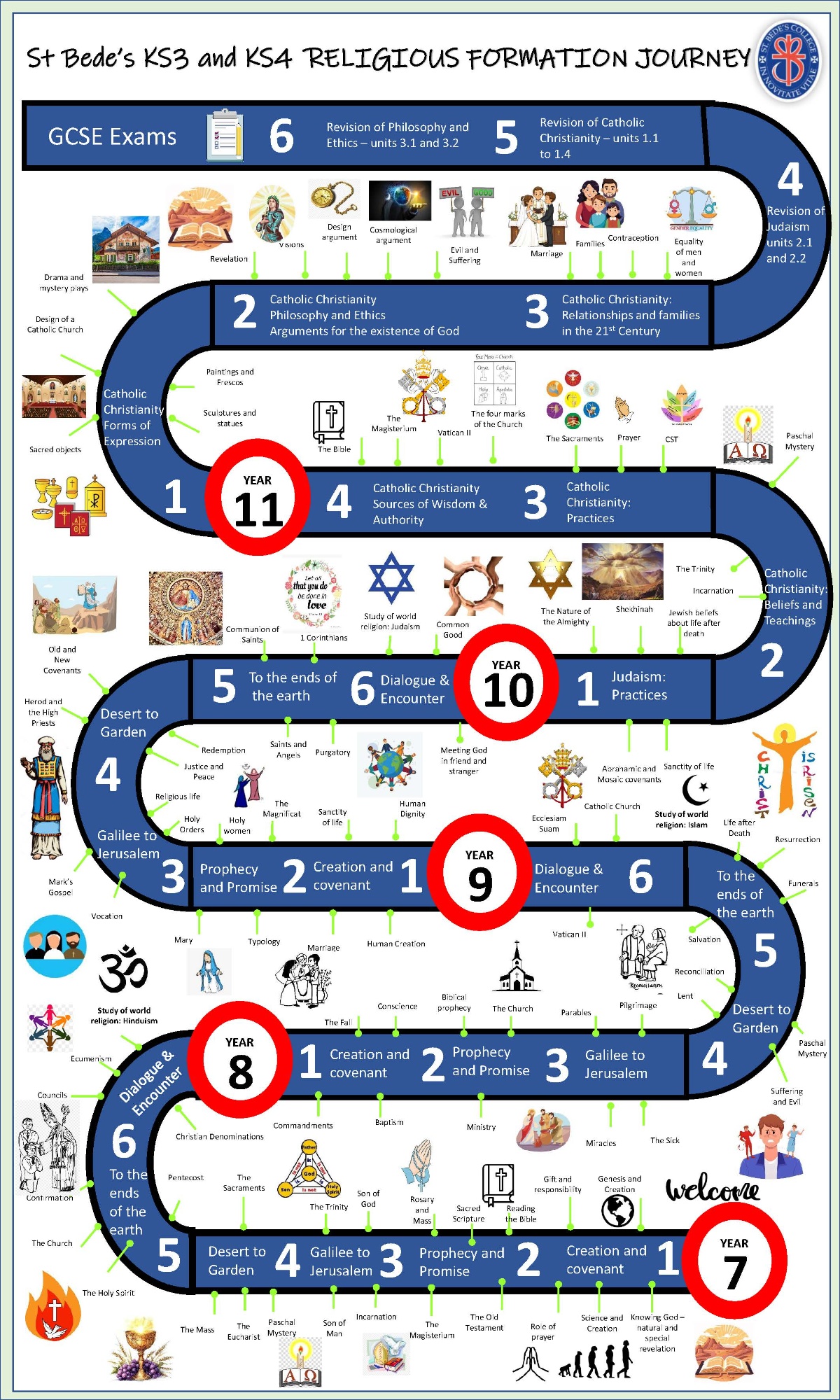
Our Religious Formation Journey
Our curriculum is carefully sequenced so that pupils build progressively on prior knowledge and develop increasing theological understanding as they move through St Bede's.
The curriculum journey below shows how learning develops from Year 7 through to GCSE.

Teaching and Learning
High-quality teaching in Religious Formation enables pupils to know more, understand more and make increasingly sophisticated connections between different areas of their learning.
Lessons engage pupils with Scripture, Catholic teaching and tradition, religious and philosophical perspectives and contemporary ethical questions. Pupils develop their knowledge and understanding through questioning, discussion, retrieval, written work and opportunities to apply and evaluate their learning.
Particular emphasis is placed upon the development of religious and theological literacy. As pupils progress through the College, they are expected to use increasingly precise vocabulary, explain beliefs and teachings accurately and articulate their ideas with growing confidence.
Retrieval and revisiting of prior learning enable pupils to make connections across the curriculum and develop a coherent body of religious and theological knowledge.
Teachers use questioning, pupils' written work and assessment to identify what pupils know and understand and where further teaching or consolidation is required.
Assessment and Progress
Assessment is an integral part of Religious Formation.
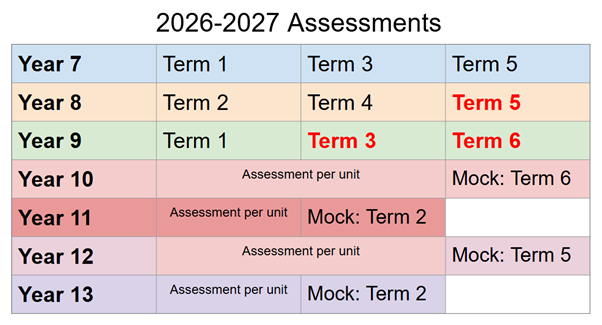
Through regular questioning, retrieval, written work, formative and summative assessment and examination preparation, the faculty monitor pupils' developing knowledge and understanding and identify areas requiring further development.
As pupils progress, expectations increase so that they are required to draw upon a broader and more sophisticated body of religious knowledge and use this independently in their responses.
The Impact of Religious Formation
The impact of our Religious Formation curriculum can be seen in the growing knowledge, understanding and theological literacy of our pupils.
As pupils progress through St Bede's, they develop an increasingly secure understanding of Scripture, Catholic teaching, the Christian tradition and the beliefs and practices of other religious traditions.
Pupils become increasingly confident in using religious and theological vocabulary; explaining and analysing religious beliefs; engaging critically with philosophical and ethical questions; and applying their knowledge to contemporary issues.
The curriculum also seeks to develop thoughtful and reflective young people who can engage respectfully with different perspectives, think ethically and make connections between faith, culture and the world in which they live.
The impact of Religious Formation will be seen through assessment information, pupils' work, pupil voice and ongoing curriculum monitoring. This enables the department to identify strengths, address gaps in pupils' knowledge and understanding and continually improve the quality of Religious Formation across the College.